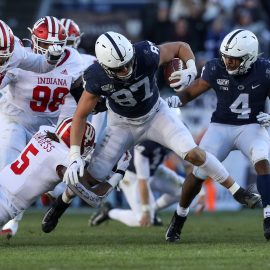
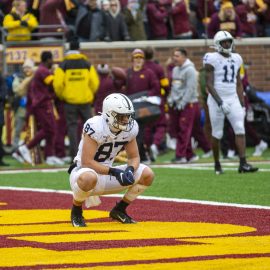
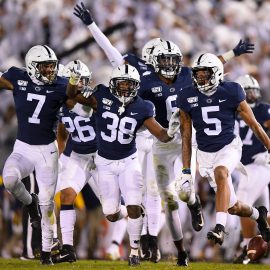
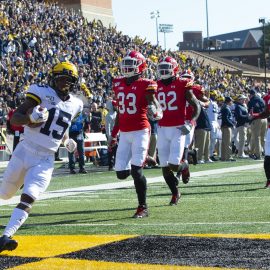
Good morning everybody. As reported here, and on every other Penn State website yesterday, Penn State will be playing a noon match at the University of Virginia next September. Feel free to sound off in the comments section if you plan on heading to Charlottesville for the game.
We open today with ESPN's Brian Bennett, who says that Coach O'Brien has actually been energized by the caravan. The article has some interesting tidbits as well, such as the fact that the coaches have yet to review spring practice together. And on Bleacher Report, Kevin says O'Brien has already done well in leaving his stamp on the program.
Other News in Penn State Football:
Bill O'Brien speaks out about the upcoming non-conference schedule. Usually when coaches talk about non-conference matches, they have to say the, "Oh, they're a good, well-coached team." At least this year, O'Brien can do that without lying.
Sorry for being a little late on this one, but the BigTen Network analyzes Penn State's schedule.
Around the BigTen:
ESPN has a list of break-out players from the BigTen. One Penn Stater makes the cut.
Ohio State fans need to forget about Terrelle Pryor. My guess? Braxton Miller's Heisman campaign in two seasons will help with that.
That's it for today's Joe. Remember to tell us your thoughts here, follow us on Twitter and Like us on Facebook.
no commentsToday the ACC and ESPN announced the broadcast information for 23 games involving ACC membrs, including the Virginia Cavaliers. The September 8 home game for Virginia against Penn State will kick off at noon in Charlottesville (not Richmond as I initially tweeted, forgetting where exactly the University of Virginia was located).
This gives Penn State two games confirmed for early kickoffs, with the homecoming game against Northwestern previsouly announced for a noon kickoff on October 6. Penn State will play two evening games, at Iowa in primetime on October 20 (8 p.m.) and host Ohio State at 6 p.m. on October 27.
You can view the updated 2012 schedule, with confirmed kickoff times and TV assignments on the schedule page.
no commentsIt is a long-standing tradition at Chicago Cubs games to have a special guest sing Take Me Out to the Ballgame during the seventh inning stretch, an ode to former announcer Harry Carey's in-game entertainment for the fans within the friendly confines. During last night's game, former Penn State kicker and Chicago Bears kicker Robbie Gould had the honor.
The video quality may not be great but here is what we could dig up from the YouTube database...
Well, he's sure no Mike Reid, but it seems to be a little bit of an improvement of his performance last year.
Follow Nittany Lion's Den on Twitter, Facebook and Google+.
no commentsWow, long time no see, NLD. As a student I was not able to contribute much to the blog during finals, but now that I'm free on summer break, the morning links are all mine again - hopefully I can live up to the standards that Kevin has set over his past few posts, though.
Anyway, my personal favorite read over the past few days was written by Penn State historian Lou Prato. It's a detailed piece about when Bill O'Brien's older brother, Tom, played Penn State as a member of the Brown University football team in 1983. There seems to be some disconnect about whether-or-not he recorded a tackle in that game, though...
In other Penn State news:
PennLive.com does a great job writing about MLB Glenn Carson and his career in wrestling. Also, Navy's triple-option offense is not easy for anybody to defend.
Victory Bell Rings has a write-up on the Coaches' Caravan's stop in Cleveland.
Outside the Lions has an intriguing article about Gottfried Fodor, the bus driver for Penn State's Coaches' Caravan.
ESPN has named Penn State's most indespensibal players. Do you agree?
Jimmy Kennedy received his Super Bowl ring yesterday. Or is that Super Bowl bling?
![]() |
| Via Jimmy Kennedy's Instagram. |
The latest expansion rumors have been swirling around Clemson and Florida State being interested in Big 12 membership. After a week of little to no substantiation of the rumors, a Board of Trustees member for Florida State made a bold statement of displeasure with the ACC and interest in the financial windfalls of the Big 12’s big football money.
The rule of thumb when it comes to expansion rumors is that when there is smoke, there eventually will be fire. The only exception to that rule over the past two years—from Nebraska’s move to the Big Ten, to the near-move of Texas and Oklahoma to the Pac-16, to the most recent Missouri and Texas A&M move to the SEC—has been Louisville and BYU’s non-invitation to the Big 12. And even that event might still be ahead of us.
While the Big 12 might continue their migration into eastern and southern markets, this all could be a threat by Clemson and FSU aimed at the SEC: take us now or we’ll open up your TV markets and recruiting soil to Texas and Oklahoma and their ilk. The SEC has two open spots, and although many assume that they would want to open up new TV markets geographically, Clemson and Florida State are emphatically the best football programs inside their current footprint.
I’m less interested in what the Big 12 or SEC ends up doing and more interested in what this might mean for the ACC. When it comes to academics and sports, the ACC is on par with the Big Ten and the Pac-12. What it lacks in football might, it makes up for in other Olympic sports, primarily basketball.
Is the ACC doomed?
The ACC has been a pillar of college athletics. For it to fall apart, it would take more than just the defection of two members. Heck, they’d still have a cool twelve members, since Pittsburgh and Syracuse are slated to join in 2013.
But as The Fixx sang, “One thing leads to another.” Ask the Big 12. Nebraska and Colorado left in 2010, and then Texas A&M and Missouri moved on 2011. Ask the Big East. Virginia Tech, Miami, and Boston College left in 2004, and then Pittsburgh, Syracuse, and West Virginia moved on in 2011. The first wave of defections might not doom the league, but a second or third wave might.
If enough of the football assets bolt (like Virginia Tech, Georgia Tech, and Miami leaving, for example, on the heels of Clemson and Florida State), that could threaten the very viability of the ACC. In a world defined by football money, a basketball-first league is only as stable as its nearest neighbor’s passivity.
Which begs the question: who on the ACC’s rolls would entice the Big Ten?
no comments![]() |
| Via Reddit |
Good morning Penn State fans. Let's get this week started right with some links to check out and catch up on.
Ryan Murphy gets our week kickstarted with the latest addition to his on-going Games of Our Lives series. Today we re-visit the 2006 triple overtime Orange Bowl, the final meeting between coaching icons Joe Paterno and Bobby Bowden. On our Facebook page, we want to know where you were when the game finally came to an end. We'll share some of your stories right here in a follow-up post, so please share your stories with us!
Big Ten commissioner Jim Delany did Michigan absolutely no favors recently with his comments about Alabama, whom he referred to as "that team" in a phone interview with the Associated Press. Delany is on record of saying that no team that doesn't win their own division should have a shot at a national championship in the upcoming four-team format, whichever method is officially put in to motion. For the record, I agree with him on that aspect, but Delany suggested that "that team" didn't play tough competition out of conference. So uh, either Delany forgot about this or he doesn't think much of Penn State either. Michigan opens the 2012 season in Cowboys Stadium against the Crimson Tide.
On Bleacher Report, a story on why the Penn State quarterback situation needs to be solved sooner, rather than later. Honestly, it's basic common sense, isn't it?
Penn State Class of 2013 tight end Adam Breneman was invited to a recruiting event in Baltimore. He shared his thoughts with StateCollege.com.
With all of the ugly stories from the Jerry Sandusky scandal, the Lasch family is heartbroken to have a building with their name involved in the whole mess.
Elsewhere...
no commentsPenn State cut its teeth as a budding college football super power in the Orange Bowl in the late sixties and early seventies. The Orange Bowl was also the stage where they would fight to regain respect on the national stage.
![]() |
| Joe Paterno's critics were mostly silent in 2005. |
Paterno saw his first three undefeated teams wind up in the Orange Bowl (1968, 1969, and 1973), victorious in low-scoring slugfests all three times. Penn State’s fourth visit was less memorable (a national championship game loss to Oklahoma in the 1985 season), but the fifth would be one for the ages.
An undefeated season wasn’t on the line. Nor was a national title this time. But the matchup between coaching titans Joe Paterno and Bobby Bowden and the unexpected resurrection of Penn State football in 2005 were storylines enough for anyone.
The hard-hitting clash between Penn State and Florida State claimed all the limelight on January 3 (the only football game scheduled and last one before the Texas/USC Rose Bowl BCS championship), and viewers were not sent to bed unsatisfied. In fact, after three overtimes, viewers wondered if they’d ever see their beds.
After enduring four losing seasons out of five, Penn State hoped its nightmare was over. Sweet dreams and a storybook ending to 2005 were just an Orange Bowl win away.
The Opponent
![]() |
| Unranked Florida State upset No. 5 Virginia Tech in the 2005 ACC Championship Game to clinch the conference's automatic BCS bowl bid. |
Most legendary programs took up football when the game was invented; Florida State (founded as Florida State College for Women) can only trace its roots back to 1947. Bill Peterson was the first to establish a winning tradition at the longtime independent school (his young assistant Bobby Bowden cemented the tradition many years later), winning a “State Championship” in 1964 with wins over the University of Miami and the University of Florida. Immortal receiver Fred Biletnikoff –a six-time Pro Bowler and Super Bowl champion with the Raiders—starred on those mid-sixties teams, eventually becoming the namesake of the award for college’s top wide receiver. Peterson’s immediate coaching successors floundered, but Bowden took the helm in 1976; the Seminoles would never be the same.
Bowden won at a steady but not awe-inspiring clip for his first decade at Florida State (11-1 in 1979 was the apex of that span), but in 1987, his dynasty flourished. After six straight top 5 AP finishes and six straight major bowl wins (including a Blockbuster Bowl over Penn State in 1990), the 1993 season brought Bowden his first national title. Florida State had joined the ACC in 1992 and promptly won the first nine ACC crowns.
An ugly loss in the national championship game in 2000 (the Orange Bowl versus Oklahoma) signaled a turn of fortunes for Bowden’s empire. Featuring the program’s second Heisman winner, QB Chris Weinke, the 2000 Seminoles still finished No. 5, but the streak would end the next year (finally rooted at fourteen straight in the record books). Bowden would never coach another team with less than three losses; the swagger of the Seminoles of the nineties became a limp in the 2000s.
The 2005 season was another disappointing one for Florida State. Accustomed to top-5 teams, the Seminoles weren’t even ranked when they played No. 5 Virginia Tech in the ACC championship game. A punt return touchdown gave FSU a boost they wouldn’t surrender, and the 27-22 upset put the Seminoles in the Orange Bowl as the ACC representative, despite their 8-4 record.
The FSU team definitely didn’t lack elite talent. A remarkable number of players were taken from the FSU defensive roster in the first nineteen picks of the 2006 NFL draft: four (LB Ernie Sims, CB Antonio Cromartie, DT Brodrick Bunkley, and LB Kamerion Wimbley). Another went fifteenth overall in the 2007 draft (LB Lawrence Timmons). The Seminoles may not have had the success of the nineties, but the NFL said they still had the skill.
The Rose Bowl is the normal destination for the Big Ten champion, but in a rare year where the BCS title game took place in Pasadena, Penn State was relegated elsewhere. The Orange Bowl selected No. 3 Penn State first to play the automatically-placed ACC champion, No. 22 Florida State. The Nittany Lions may have liked to have squared off against a more highly ranked foe (No. 4 Ohio State faced No. 6 Notre Dame in the Fiesta, and No. 7 Georgia got No. 11 West Virginia in the Sugar), but the chance to see legendary coaches Bobby Bowden and Joe Paterno—76- and 79-years-old respectively—stand toe-to-toe one last time made TV execs and sponsors salivate.
no commentsLeading in to the announcement of the 2012 College Football Hall of Fame Class, the National Football Foundation highlights members on the Hall of Fame Ballot. The 2012 Class will be announced on May 15 in New York City. Today they profiled Penn State's Steve Wisniewski

SCHOOL: Penn State
POSITION: Offensive Guard
YEARS: 1985-88
ATHLETIC ACCOMPLISHMENTS: Wisniewski was instrumental in helping running back Blair Thomas rush for 1,414 yards and 11 touchdowns in 1987 and helping D.J. Dozier attain First Team All-America honors in 1986. He was named a co-captain and team MVP as a senior in 1988. Wisniewski was a member of Penn State’s 12-0 national championship team in 1986, and a freshman on the Nittany Lions’ 11-1 club in 1985. Overall, he helped College Football Hall of Fame coach Joe Paterno and Penn State achieve a 36-11 record and appear in three New Year’s Day bowl games.
CIVIC SERVICE: A licensed minister, Wisniewski often volunteered at the Well Christian Community Church in Dublin, Calif. He made two trips to visit U.S. military personnel in Afghanistan and Iraq. Wisniewski began youth sports coaching in 1995 and participated in numerous inner city/international mission trips. He regularly serves as guest speaker for various functions and charitable organizations.
NOTABLES: Wisniewski, a longtime Oakland Raider, formerly worked for the Raider TV Network following the end of his playing career. His nephew, Stefen Wisniewski, was named a 2010 NFF National Scholar-Athlete and now plays for him in Oakland.
no commentsIn the aftermath of the late-April commissioners’ meeting in Florida where they discussed college football’s post-season, three key questions emerged going forward. Will there be a playoff? Where and when will the games be played? How will the teams be selected?
The first was seemingly answered. There will be a playoff, and it will include four teams.
The second will be debated for the next few months and will likely be answered in mid-June when the commissioners reconvene. The semifinal games will be played either on the higher seed’s campus, at the traditional BCS bowl sites, or at a neutral site which rotates yearly. The championship game is likely to be bid out to any city like the NFL’s Super Bowl.
The third question though includes a far more dynamic debate, one whose essence made the BCS the thrilling and infuriating entity it was for nearly two decades. Who gets in? Who is left out? And how do you decide?
The Three Proposals
One proposal is to use conference champions only. (The Pac-12’s Larry Scott most vocally preferred this.) This is somewhat objective, as everyone can clearly see if a team won or lost its final game. However, with more than four conferences in play (six if you consider the current BCS conferences and eleven if you consider all FBS conferences), even this proposal would need some kind of poll to sort out the best champions.
Another proposal (like the one the Big Ten’s Jim Delany mentioned last week) is to only include conference champions in the top 6 and then admit teams who aren’t champs by highest ranking. Again, this system requires a poll and is a little less easy to grasp for the casual fan. The spirit of this proposal is to reward conference champs but not to exclude exceptional teams who can’t win their conference.
The other major proposal puts all the emphasis on the poll. It begs for a straight top 4, without any confusing exceptions or snubs of higher-ranked teams. This system seems to be most popular currently (especially with the SEC and Big 12, who believe they could place multiple teams in the top 4 regularly).
To simplify the zeitgeist of the debate, those who prefer the conference champs models believe that being the best in your league should hold sway. “If you can’t win your own league, how can you win the entire national title?” they ask. Those who prefer the “top 4” model believe that being ranked as a top team matters more than having one team ahead of you from your own league. They ask, “Isn’t it possible that the two best teams in the country do indeed come from one conference?”
I think they’re both right. And I think both sides will get their way when all of the new playoff’s questions are answered. How can that be, you ask?
The common denominator in all of these scenarios is a poll, and a poll ain’t nuthin’ but the criteria that people want to put in it.
no comments 
This week is the shortest episode so far! We got a lot of results packed in (0:00-17:26) as well as previews for the upcoming weekend (34:48-end). We also talked about some of the latest news in the running world (17:27-24:14 ), including Ryan's debut half marathon! A big topic this week was our "training topic of the week": increasing mileage (24:15-34:47). Next week we will wrap up the conference championship meets and look ahead to NCAAs as we move towards Eugene 2012!
Links mentioned on this week's show:
Is the 10% mileage buildup rule a good one?
Cam Levins is fast, AND he runs 150 miles each week
Be sure to subscribe to the NLD podcasts on iTunes!
Follow The Runner's High Podcast on Twitter, Facebook and email us at This e-mail address is being protected from spambots. You need JavaScript enabled to view it .
Follow Nittany Lion's Den on Twitter, Facebook and Google+.
no comments